Brevity.
Doctor Who One Word Test from Duke Skymocker on Vimeo.
This scene made a good impression impression the first time I saw it.
It appeals to me on a more practical, minimalistic level now.
I shall work on being concise.
Doctor Who One Word Test from Duke Skymocker on Vimeo.
This scene made a good impression impression the first time I saw it.
It appeals to me on a more practical, minimalistic level now.
I shall work on being concise.
The media are in a frenzy today with stories about the Boston Marathon bombings. KGO Radio’s coverage this afternoon was entitled, “Terror in Boston: The Aftermath”. The portions of this broadcast I heard were characterized by discussions of how little we actually know and descriptions of “high alert” security measures being enacted in major cities across the United States.
I don’t wish to make light of the events at the Boston Marathon yesterday, and I very much look forward to hearing that the perpetrator has been caught and brought to justice. My heart goes out to the families who’ve lost loved ones and the individuals in pain as a result of these events. But with those things in mind and in light of how little we actually know about what happened and why, I feel it necessary to say:
Let’s keep a sense of scale here.
Here are some notable mass killings in the United States in the past 20 years, in order of increasing lethality:
| Name | Date | Location | Dead | Injured |
|---|---|---|---|---|
| Centennial Olympic Park Bombing | 07/27/96 | Atlanta GA | 2 | 111 |
| Boston Marathon Bombings | 05/15/13 | Boston MA | 3 | 183 |
| Batman Shooting | 07/20/12 | Aurora CO | 12 | 58 |
| Columbine High School Massacre | 04/20/99 | Littleton CO | 15 | 21 |
| Sandy Hook Elementary School Shooting | 12/14/12 | Newtown CT | 28 | 2 |
| Oklahoma City Bombing | 04/19/95 | Oklahoma City OK | 168 | 680+ |
| September 11 Attacks | 09/11/01 | NY VA and PA | 2996 | 6000+ |
That really puts things in perspective, don’t you think?
The Boston Marathon attack yesterday was one of the least fatal attacks in recent history. We have no idea whether it was perpetrated by an organized terror group, a single unbalanced individual, or some other sort of organization altogether. We have no concept of what the motive was or when or how or where the attack was planned and prepared. It much more closely resembles in scale the 1996 Olympics bombing (perpetrated by an American member of a Christian terrorist organization) and last year’s shooting at a movie theater in Aurora, Colorado (in which the shooter was a single individual of unclear mental health status working alone).
What all of this adds up to is one simple conclusion:
DON’T PANIC.
In 2001, the September 11 attacks resulted in a dramatic curtailing of our liberty, which has done little to make us more secure and much to make us less free. Those attacks were also used as a flimsy pretext for an unwarranted war in Iraq (an act of terror which has killed significantly more Americans than the 9/11 attacks themselves).
What was described on the radio today as taking place across the nation today is what we call “disproportionate response” (everywhere except for Boston, where immediate response is warranted). People are already talking about terrorist groups, speculating about war, grounding flights because they hear people speaking Arabic, and just generally allowing the terror to take hold.
STOP IT.
If we allow the terror to take hold — if we use this as a pretext for more unjust killing, if we allow our government to use it to deprive us of more of our freedom — the terrorists have won. You’re doing EXACTLY WHAT THEY WANT YOU TO DO.
Wait for the investigators to do their jobs and to come up with some information that’s actually worth acting on. Until then…
Keep calm and carry on.
In Which I Turn to Douglas Adams for Advice on the Boston Marathon Bombings Read More »
Tonight I tried to drop by my blog and found that it was out of commission! No WordPress pages would load (although non-WP static HTML pages were fine), instead giving me a browser error message explaining that the server returned no data. I checked the filesystem and found the files intact and not recently edited (I had been hacked once several years ago and thought this might have been malicious as well). I headed over to the database (fortunately phpMyAdmin was working) and looked around the DB a bit. The last change there was from 2/25. ಠ_ಠ
A little bit of Googling led me to http://www.colinmcnulty.com/blog/2008/07/08/solution-to-wordpress-blank-screen-of-death/ where I found the solution. Fortunately, my problem was not the same as his, but following the steps that didn’t work for him did work for me. Evidently something went wrong with my plugins; disabling them all directly from the database magically restored my web site. I logged back in, upgraded from Word Press 2.7 to the latest 3.5.1 (big jump!) and here I am. In response to my snark on Facebook about everybody letting that go almost two months without telling me, my coworkers persuaded me that I should do more self-promotion and update more often, so here’s a post. I try not to post here unless I have something useful to say (no “I ate a piece of toast today” updates on this blog; that’s what Facebook and Twitter are for), but hopefully that link will help some poor soul whose Word Press site spontaneously decided that it didn’t need to serve pages anymore.
Just, y’know, ignore the bit at the end where it turns into a sales pitch. ಠ_ಠ
I got lazy and stopped posting; my web site got lazy and stopped loading. Read More »
“The man who doesn’t read good books has no advantage over the man who can’t read them.” -Mark Twain
A quick search of the interwebs turned up several instances of this quote on different sites, but no context. As such, I can’t be certain whether it was intended solely in a literal sense, or if Clemens was using it as an example and a metaphor for a broader idea. I prefer to think the latter, however, as it seems equally true for pursuits other than reading.
To generalize the sentiment, we could say: The person who fails to wisely apply their talents has no advantage over those who lack them.
I think I’ve been stuck in a rut lately of allowing many of my talents to fall into disuse, and thereby deriving no value from them. Fulltime employment (perhaps paradoxically?) increases the challenge of making use of any but a narrow subset of my skills, as few of them are relevant to my position. Employment consumes more of the time and energy available to me for such pursuits than I actually have, leaving me destitute of one or both at the end of each day.
I am not sure what to do about this, except to try to squeeze in a little bit here and there. This blog entry, for example, is a baby step toward keeping my writing skills sharp. It was begun on the bus this morning, tapped into the keyboard of my phone, and completed this evening, in a narrow slice of time between finishing the laundry and heading to bed. I’ll try to do likewise tomorrow. The “micro-blogging” medium of Twitter and Facebook is suitable only for the most superficial of updates; to say anything that has any meaning to either myself or anyone else requires more space. So I suppose I’ll try to do “mini-blogging” instead. Not the long, detailed posts I would prefer to write had I the time and energy, but whatever words I can wring out onto your screen in the space between the things it seems I have to do.
Like going to bed, roughly now-ish.
Twain always has something relevant to say. Read More »
We spend a lot of time and energy on making software usable and user-friendly, and with good reason. It only makes sense to make the computer adapt to the user, not vice versa. So why is it that we don’t give this kind of attention to the tools the we as technologists use every day? When is the last time you saw a beautiful, easy-to-use language or API reference? It seems to me that there’s a lot that could be done to make these gargantuan beasts easier to use. Things like configurable sort order:
Language and API references tend to be huge and difficult to use, and there’s no reason at all why this should be.
A Quick Thought on Language and API References Read More »
Yesterday, my friend Carlos posted about the core web design tools that he uses on a regular basis. I thought I’d chime in and mention some of mine, particularly as Carlos is a Mac user and some of his tools aren’t available for Windows, which is where I get most of my work done.

For Launchbar-like keystroke launching functionality on Windows, Launchy is a great choice — and free!

Like Carlos’s pick, TextPad supports syntax coloring for a number of languages. It’s also extensible — you can define new document classes and color them yourself, or download user-defined document syntax definitions created by the TextPad community.
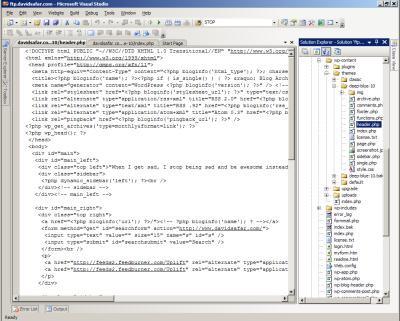
Yes, even though PHP is my language of choice, I sometimes find myself turning to the Evil Empire’s software development tools to work on it. MSVS has exactly one thing going for it: the slickest implementation I’ve seen of simulated in-place editing of files on a web server. This is such an important feature and so few programs seem to support it. Linux can easily and freely be extended to treat an FTP site as part of the local filesystem, but until Windows offers the same ease-of-use in this regard, it falls to the application vendors to offer this feature. Kudos to Microsoft on getting this one right — in their programming tools if not their operating system!
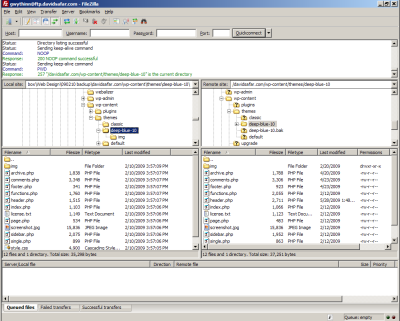
Because not everyone is onboard with simulated in-place editing, I often find myself needing to perform the edit-and-upload cycle manually. FileZilla does a fantastic job of giving me the FTP functionality I need with the ease-of-use I desire.
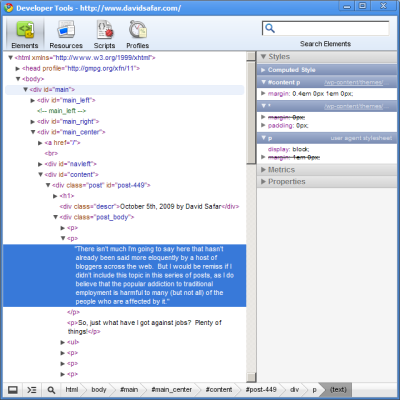
Not much I can say here that Carlos didn’t already mention, except that Chrome is my browser of choice rather than Safari. It’s still based on Webkit, though.
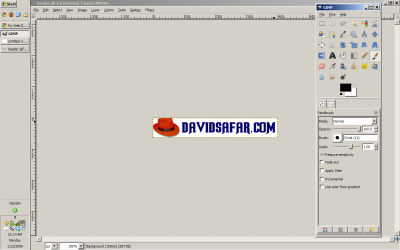
Lately I find myself doing a fair bit of graphic design work. That means I spend a good chunk of time working with The GNU Image Manipulation Program, the free open-source alternative to PhotoShop. All my screenshots for this post were made with Windows’ built-in screenshot functionality pasted into The GIMP.

I must admit, the visual aspect of web design is not my forte, I’m more of a tech guy. That means that anything I can lean on to help me make things look spiffy is extremely useful. One example is this nifty Color Palette Generator, which allows you to upload an image and derive a color palette from it. Use this with a logo to generate a similar palette, or a nature photo to come up with something that’s naturally aesthetically pleasing. Very handy!
Those are the tools that work for me — what about you?
(Many thanks to Carlos for inspiring this post to my oft-neglected Technology category!)
My Web Development Toolbox Read More »
Next up in my survey of things that are overrated is traditional employment: jobs are overrated!
There isn’t much I’m going to say here that hasn’t already been said more eloquently by a host of bloggers across the web. But I would be remiss if I didn’t include this topic in this series of posts, as I do believe that the popular addiction to traditional employment is harmful to many (but not all) of the people who are affected by it.
So, just what have I got against jobs? Plenty of things!
“Psychiatrists declare that most of our fatigue derives from our mental and emotional attitudes… What kinds of emotional factors tire the sedentary (or sitting) worker? Joy? Contentment? No! Never! Boredom, resentment, a feeling of not being appreciated, a feeling of futility, hurry, anxiety, worry–those are the emotional factors that exhaust the sitting worker, make him susceptible to colds, reduce his output, and send him home with a nervous headache. Yes, we get tired because our emotions produce nervous tensions in the body.” -Dale Carnegie from How to Stop Worrying and Start Living
‘Nuff said.
On the whole, employees in many companies are treated like children. They are required to get up at a time determined by someone else’s whims, go where they are told to go, sit where they are told to sit, do what they are told to do the way they are told to do it, risk, receive less in compensation than the value they create for the employer (by necessity — if they didn’t, the employer wouldn’t make any money), run the risk of their income being cut off at any time for any reason or no reason at all. If they disobey the authority figures, a system is in place to discipline them and bring them back in line. A routine of this nature was not fulfilling, beneficial, enjoyable, or conducive to personal growth and well-being in elementary school, nor is it any of these things in adult life. This is a system designed to force individuals to sacrifice their well-being for the good of the company without regard for their individuality, liberty, or humanity.
Isn’t it ironic so many of us in the so-called “free world” willingly choose to live as slaves?
This is the reason why I seek self-employment, and why I would suggest that anyone who is dissatisfied with traditional employment do the same. Freelancers set their own hours (which, admittedly, may be long, but that is a personal choice and not an arbitrary requirement imposed by others), their work, their clients, their methods, their workplace (where applicable), and their compensation and benefits (limited only by the amount of business they are able to do). The freelancer has the power to make decisions and to quickly change things that aren’t working, and with multiple clients comes a security from sudden and immediate lack of income — if you lose a client, only a fraction of your income is lost instead of all of it. If you have a profitable idea or increase your value as a worker, you personally reap the benefit of that in your income. You can focus on types of work that are less fatiguing to you, and if you find yourself feeling stressed anyway, you can take a break. Self-employment has a great many benefits over regular employment, and while it’s not a panacea and there are indeed people who are perfectly happy with their jobs, I think the world would be a happier place if more of those who are dissatisfied with traditional employment investigated self-employment as an alternative.
(Note: This song has a long intro which starts very quiet — it may take several seconds after you press play before you actually hear anything.)
Jobs Are Overrated Read More »
We live in a world where degrees are overvalued and misinterpreted, and from an efficiency standpoint, I understand why this is. It’s very difficult to thoroughly evaluate the depth and breadth of a person’s knowledge, so degrees serve as a shortcut of sorts. They supposedly offer proof (or at least evidence) that the possessor has learned a certain set of information and skills, both specific to a field and of general use. In truth, though, they are often more a measure of tenacity than of learning. If you can follow directions and buckle down and do what you’re told, you can get a degree, and that degree will be indistinguishable from one earned by somebody who learned and explored and bettered themselves. And although the degree is a poor measure of a person’s retention of knowledge and abilities, it’s the system that’s in place and until something better comes along, it’s what people will continue to use. And I can’t blame them — who has the time to do a comprehensive analysis of every job candidate’s true level of education, and how many job seekers would tolerate it? No, we can’t get rid of degrees, however inadequate they may be.
As an aside: my father works in IT for a government contractor. Co-workers are often impressed by the depth of his knowledge, and from time time to time will ask where he got his degree. They are often surprised to learn that he has none. This reaction is ludicrous. It’s as if the population has been brainwashed into believing that attending a major university is the only way to learn anything. Perhaps this is the reason so few people read anymore — maybe they believe they cannot possibly learn anything from it because there isn’t a professor or tuition involved.
What a horrible way to live your life.
There is a solution, however to this whole “degree” mess, for some people if not for everyone. That solution is self-certification.
I encountered the idea of self-certification at a talk given by Cem Kaner, a prominent figure in the world of software quality assurance. Mr. Kaner was asked whether he believed it was worthwhile to pursue the numerous “testing certifications” available to QA professionals. He recommended instead a path of self-certification, which he explained consists of writing articles, giving talks, and generally making a name for oneself in one’s chosen field. Effectively, if your reputation precedes you, your lack of a degree is irrelevant.
This, I imagine, plays better with a self-employed lifestyle than with traditional employment, although I can’t imagine that being a recognized authority in your field could fail to help you get a traditional job. But self-certification requires some attributes that formal education either does not or helps to provide. To become self-certified, one must be internally motivated — there are no due dates or deadlines, no assignments to complete, no tests to study for, except those that one chooses to seek out. It requires a much more pro-active approach than going to school, where your primary task is to do what you’re told. Self-certification requires you to seek out ways to contribute, opportunities to create and share within your field, chances to get your name out there by helping others in a public forum.
Self-certification is a very different type of process (and in some ways a more valuable one) than seeking a degree. The very act of seeking to make a name for yourself in this way is a double win — your skills improve, allowing you to provide even greater value, while you simultaneously approach your goal of having a way to demonstrate the value that you already have. By pairing the strategies of self-education and self-certification, you can avoid the inadequacies of both traditional education and the degree system that goes with it.
Degrees Are Overrated. Read More »
(Note: This is a repost of an article which appeared on my LiveJournal on January 24, 2009. I am transferring it over because it is the first in a series, which will be continued soon.)
I’ve never been a fan of formal education.
Maybe it works for some people, but it never worked all that well for me. I’m just a self-directed kind of guy, and working on someone else’s tasks to someone else’s standards on someone else’s schedule is nothing but irritating to me, and it hampers my education. The bottom line is that I love learning, but I can’t stand being taught.
My biggest problem with formal education is pacing. Most classes run at a fixed pace for a fixed period of time. That just isn’t how I learn best. Sometimes I make a cognitive leap in a subject and want to keep learning non-stop for hours or days on end. Other times I’m just not feeling it and the best thing I can do is set the subject aside for a while (hours, days, weeks, months, or even years) and let the concepts I’ve already absorbed gel before proceeding. Maybe I’m unusual in this regard, but I think it more likely that teaching at a constant pace is a sub-optimal system for many students. Even students who learn well at a constant pace will probably prefer a pace quicker or slower than what the instructor has chosen.
There is, however, a reasonable argument to support this system. It’s easier to teach if everyone’s learning the same thing at the same time at the same pace. It’s also easier to tell if someone’s falling behind, in the instance where there’s a deadline involved. Reluctant students may be more likely to complete a class if there are numerous fixed checkpoints along the way. Thus, our traditional educational system works in favor of the instructor and the least common denominator. The focus is on the numbers, working to herd students through the system in the largest numbers possible with the least inconvenience and cost.
This means that the students with the most potential must either fend for themselves or slip through the cracks. It’s sad, but it’s true, and it’s far worse in high school than it is in college. I was very disappointed in the “education” I received from my high school, which was very proud of its status as a “California Distinguished School”. My brief stay in Portland taught me, through meeting high school students and speaking to their parents, that Oregon schools are even worse. I advised one student there that if she wanted an education, she would have to take responsibility for it herself. High schools aren’t interested in educating kids, they’re only interested in processing them through the system with a minimum of fuss and hassle.
“I have never let my schooling interfere with my education.”
-Mark Twain
And really, that’s the key. If you want an education, you must take responsibility for it yourself. I can’t tell you how much harm I’ve done to my education in my younger years by misguidedly allowing my schooling to interfere with it. I permitted the school to persuade me that they were taking responsibility for my education, and sat back in expectation of its delivery. I was appalled by the paper-shuffling busy-work that I got instead, but continued waiting for the fulfillment of the promise, encouraged by the words of the adults in my life. In elementary school, “you’ll like middle school better”. In middle school, “you’ll like high school better”. And in high school, “you’ll like college better”. And finally I left high school early to go to Middle College, because every level of schooling before had utterly failed me. I had become more and more unhappy as the promises that things would be better next year proved to be not only empty, but bitterly ironic as things got WORSE every year. It wasn’t until I rejected traditional schooling and sought out an alternative program that I found a way to even make the situation TOLERABLE enough to graduate (and even then, not on time).
My bad… though I don’t know what I could have done differently with the limitations (both real and imagined) and lack of information I had to work with at the time.
But there is a solution to these problems, at least for those who are no longer beholden to the educational system. There’s a viable alternative to a college education — a college-level self-education. You may not wish to get the knowledge you seek from schooling, but you have to get it from somewhere, and believe me, it’s out there! I’m working out the details of how to go about this right now. It seems to me that the first step is to work out a curriculum — you have to know what you want to learn (perhaps not everything, but at least a starting point) before you can begin to assimilate knowledge. This is the step that I’m working on now, and is what prompted me to inquire about what should be included in a well-rounded education. I’m presently in the position of being able to design one for myself, and want to put some thought into it rather than just accept the structure that was thrust upon me by a system that thoroughly alienated me.
After deciding the general categories of my education, I’ll be narrowing each down to an initial focus, investigating and choosing educational resources, and beginning to read — I do expect that most of the knowledge I’m looking for will be found in books, despite my personal preference for the Internet as a source of information.
There’s still a hiccup in this plan, which I will investigate in another post — independent scholars face an additional challenge in having their studies recognized by those (such as employers) who use such things as a basis for decision-making. There are, of course, exceptions and ways around this, but as I said, that’s for another post.
Formal Education Is Overrated. Read More »
At the beginning of June Chris Guillebeau posted an article on his blog about community building. It couldn’t have come at a better time for me, as community is one of the things that’s been on my mind with regard to how I want to keep myself busy. As I noted in my last post, self-unemployment has not been conducive to a sense of community in my life. As a reminder, I defined community as having other people to interact with who are on the same or a similar path, people who want what I want and who can help me when I need it and accept my help when they need it. In his post, Chris Guillebeau defines a community as “a group of people united through a common struggle with the same stories”. His definition is more concise than mine, but I think we’re getting at the same idea.
Community is one of the few positive aspects of traditional employment. A traditional workplace gathers people together and provides them with a common struggle, resulting in the same stories. The common struggle may be against the competition, the management, or even the customer, but it is present regardless, and often results in a camaraderie in the rank and file. That’s something I’ve taken for granted in the past, and something which is not native to self-employment. When community is not provided, it must be sought out or built instead.
I think it’s important to have a community for any major goal you are trying to achieve. As I noted when I began this incarnation of the blog, I think it’s true that most of the problems people have in their lives are in the areas of health, wealth, and relationships. So it stands to reason that it would be helpful to be a member of a community in each of these three areas. Interacting with people who have similar ideas and goals as you do in these key areas can only help you stay on track with your goals, continue learning, and provide opportunities for growth (sometimes unexpected ones!).
I am currently following several blogs connected with these topics, and while these are fascinating and help me to feel less isolated as I read about people with similar struggles and stories, I think the facility of the Internet to connect people has its limits. Although I owe many of my in-person friends to connections made online, I think that if you don’t take these relationships into the real world, they will necessarily be stunted. Internet communities are valuable, but cannot take the place of face-to-face interaction. (Some of you may be surprised to hear this opinion from me of all people. To be honest, I’m a little surprised to hear it from myself.)
With that in mind, I want to find both online and offline communities with similar outlooks on health, wealth, and relationships.
In terms of health, I want to connect with people who are interested in losing weight and building muscle without expensive gym memberships or equipment. Cardio, weight-lifting, and calisthenics are topics of interest, as well as healthful, inexpensive food with plenty of fresh fruits and vegetables (i.e. fiber).
I read a bit about personal finance, and a lot of people are talking about getting out of debt, managing money, investing, and so forth. But I am more interested in the other side of the wealth equation, and would like to interact with people who discuss income generation — entrepreneurs, freelancers, and others with alternative approaches to employment and ideas about how to succeed on these paths.
Relationships are a little different, and I’ve already identified communities relevant to my interests and learned a lot from them, though I haven’t participated as much as I would like. I’ll go into this in a little more depth in another post, as it deserves a more in-depth treatment.
But people skills have never been my forte, and I’m not quite sure how best to go about finding groups of people who are already on these paths. Being who I am, Internet resources are first to spring to mind:
These resources can help to find groups of people who are talking about these things both on the ‘net and off, but how would I go about locating such people if I didn’t have the Internet at my disposal? What groups are you a member of and how did you find them? Are you looking for a greater sense of community? As always, comments are welcome.